What makes a smart metering pilot credible in remote communities?
A good pilot story is often less about advanced capability and more about a credible first operating model.
A useful question came up in a recent conversation about a remote-community water pilot in Western Australia:
Where does the metering capability actually fit?
Not in theory. In delivery.
The interest was there. So was the service need.
But the discussion quickly moved away from the technology itself and toward a more practical issue: how would the pilot be assembled with as few interfaces as possible?
That changed the shape of the problem.
This was not just a metering pilot. It was an operating model decision. The risk was not in the dashboard. It was in the handoffs behind it.
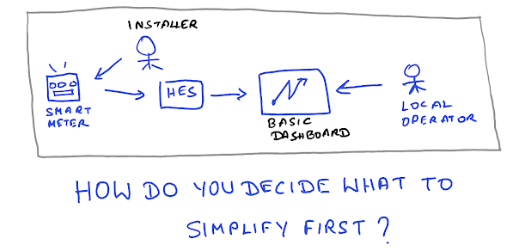
The setting made that clearer. Some communities have limited infrastructure. Installation would depend on accredited parties.
Equipment sourcing matters.
Data ingestion is only useful if it lands in a very simple view.
And even then, the likely first users may not be accustomed to working from that data today.
That is a familiar utility modernization pattern.
The technical idea can make sense before the delivery path does. The data can be valid before the operating model is ready for it.
For executive leaders, that matters because a pilot can look small on paper and still carry a lot of hidden integration uncertainty.
If ownership, user readiness, and delivery boundaries stay implicit, the pilot may collect data without improving service.
In remote settings, simplicity is not a nice-to-have. It is part of the design.
A good pilot story is often less about advanced capability and more about a credible first operating model.
When you scope an early pilot in a low-maturity environment, what do you simplify first: the technology, the interfaces, or the user workflow?
— Pradeep
P.S. You've received this email because we're connected on LinkedIn. Feel free to unsubscribe if the insights are unrelated.