
VPP growth creates a different kind of operating problem
As VPPs scale, the harder question is not just how much capacity is enrolled. It is whether response can be explained when it matters.
The VPP market is growing quickly.
That is good news for flexibility, customers, retailers, aggregators, and the grid.
But there is a quieter operational question sitting underneath the growth story:
What happens when enrolled capacity does not turn into expected response?
For an operations lead, this is where the real work begins.
A VPP can show impressive capacity on paper. More batteries. More EVs. More hot water. More HVAC. More controllable load.
But during a live event, the useful questions are much more specific:
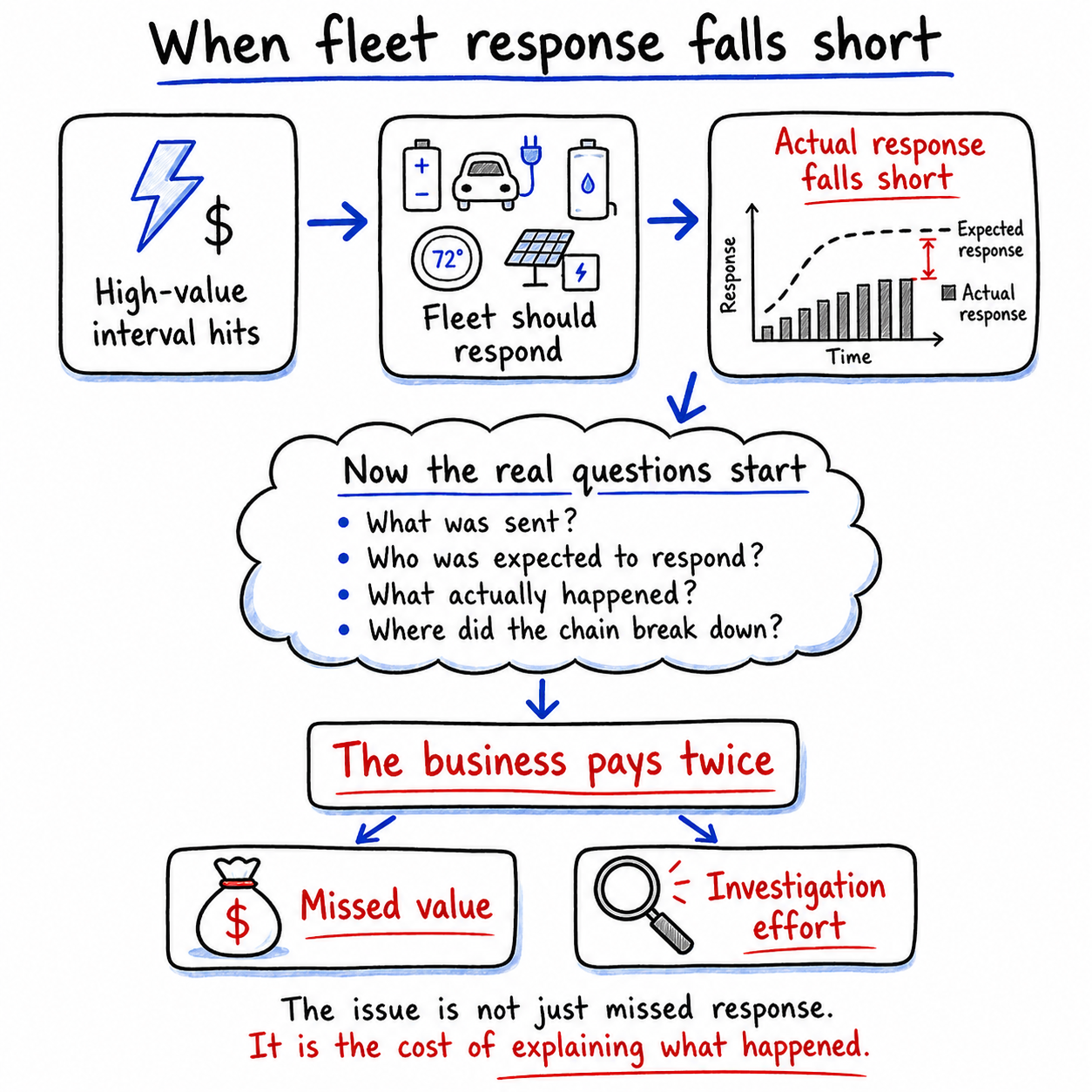
What signal was sent?
Which assets or cohorts were expected to respond?
What actually happened?
Where did response drop, delay, or become unclear?
What needs attention before the next event?
This is the shift I think matters.
The market often talks about VPP growth in headline capacity.
Operations teams feel it as exception volume.
As DER programs scale, unclear response becomes more expensive.
Not only because value is lost in the event itself, but because time is then spent reconstructing what happened afterwards.
That investigation effort can hide inside spreadsheets, Slack threads, platform exports, manual checks, customer state reviews, device status checks, and telemetry comparisons.
One missed response may be manageable.
Repeated unclear response across multiple asset classes, control pathways, and market products becomes a cost-to-serve problem.
This is why “VPP maturity” cannot just mean more enrolled MW.
It also has to mean clearer signal-to-response workflows.
Teams need to know what was sent, who was expected to respond, what actually happened, and where the breakdown occurred.
Not in theory.
In the live operating workflow.
This does not require boiling the ocean.
The better starting point is usually one costly workflow.
One event type.
One asset cohort.
One control pathway.
One recurring response gap.
Make that visible first.
Because once the team can see the gap clearly, they can make better decisions about what to fix next.
The market may be growing in capacity.
But operational advantage will come from knowing which parts of that capacity can actually be trusted when called.
If this is becoming a live issue in your DER or VPP operations, I’d be interested to compare notes.
— Pradeep
P.S. You've received this email because we're connected on LinkedIn. Feel free to unsubscribe if the insights are unrelated.