
The hidden decision gap in smart meter to OMS programs
The hardest part is not moving meter outage data into OMS. It is deciding when that signal is trusted enough to change operational truth.
Real situation
A utility wants to use smart meter outage and restoration telemetry to improve OMS visibility during storm events. (Ref: Bluecurrent AU/NZ)
The intent is sound: better outage extent awareness, faster recognition of who's ON and who's OFF, and more confident restoration decisions.
What looks correct on the surface
The architecture path seems clear.
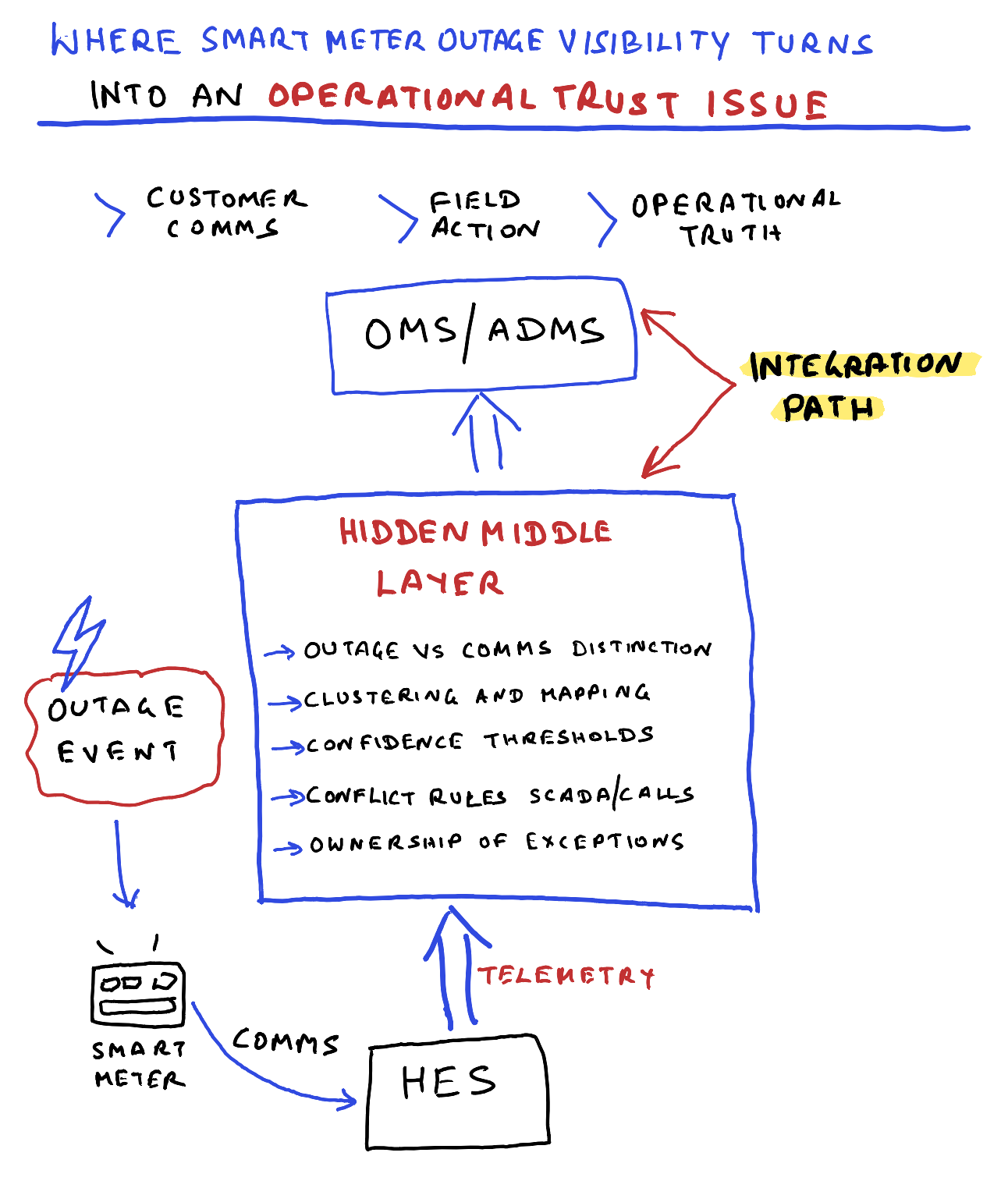
Meter events move through comms and head-end systems.
They are passed into OMS alongside SCADA, topology, calls, and field input.
The business gets better visibility.
That sounds reasonable. It is also incomplete.
What is actually unresolved
The signal does not arrive as operational truth.
It has to be interpreted first. Raw events must be filtered, clustered, mapped to network context, and confidence-scored before operators can use them safely.
That middle layer is also the least clearly owned. That is where hidden execution risk sits:
- what counts as outage vs comms failure
- what confidence threshold operators will act on
- how conflicts with SCADA, calls, or field reports are resolved
- who owns tuning when live conditions expose flaws
- how much trust customer comms are allowed to place in the signal
Core insight
Outage visibility only helps when the utility decides what telemetry is allowed to mean.
What must be true to capture the utility intent
- The first use case must be narrow and defensible.
- Smart meter signals must carry explicit confidence context.
- Conflict rules with existing outage sources must be set before go-live.
- A named owner must hold the interpretation logic.
- Restoration confirmation must require stronger proof than outage indication.
Broader pattern
This is what I often see in complex utility programs.
The visible work is the interface. The hidden risk sits in the meaning layer between systems, teams, and live decisions.
That is where delivery can look ready before trust is ready.
Aurion’s role is to make that hidden layer visible early enough to improve defensibility and delivery confidence.
Executive takeaway
The decision is not whether to integrate smart meter signals into OMS.
The decision is whether there's clear definition of the conditions under which those signals are allowed to influence operational truth.
— Pradeep
P.S. You've received this email because we're connected on LinkedIn. Feel free to unsubscribe if the insights are unrelated.
 Matt Bostwick
Smart Meters based outage detection service - Bluecurrent