
The new bottleneck in residential VPPs
Residential DER visibility is improving, but visibility alone does not prove response. The harder operating question is what happened after the signal: who should have responded, what the fleet actually did, where response leaked, and what the evidence supports.
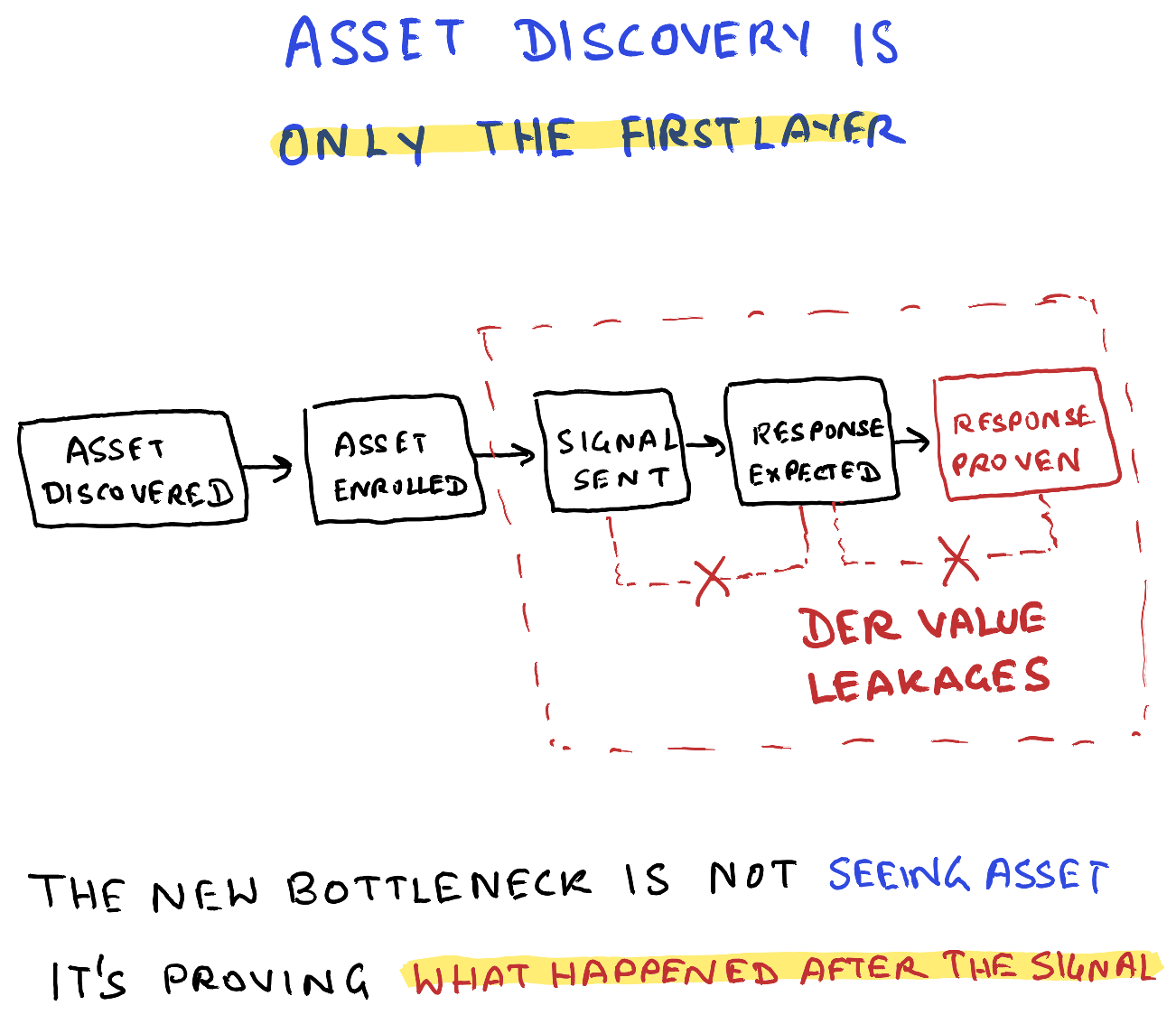
It's not asset discovery. But proving response after the signal (price, network, market operator).
A lot of the residential DER conversation is focused on asset discovery.
That makes sense.
VPPs and aggregators need better visibility into batteries, EV chargers, hot water systems, HVAC loads, inverters, flexible load, and household-level behaviour.
You cannot operate what you cannot see.
But there is a second problem that becomes more important once the asset is visible.
Asset discovery is not response proof.
- Knowing a device exists does not prove it responded.
- Knowing it is enrolled does not mean it was usable.
- Knowing it is technically controllable does not mean the control pathway worked during the event window.
The deeper bottleneck appears after the signal.
When a pricing signal, network signal, tariff signal, FCAS opportunity, or dispatch instruction arrives, the operator needs to know more than what assets exist.
They need to know what actually happened.
The response chain is where reality shows up
A residential VPP event looks simple from a distance.
A signal arrives.
A cohort is targeted.
The fleet responds.
But in real operations, the path is less clean.
The signal-to-response chain usually looks more like this:
Signal → intended cohort → control pathway → asset state → telemetry → evidence review
Each layer can introduce uncertainty.
A signal may land correctly, but the intended cohort may include assets that are eligible on paper and unavailable in practice.
A control instruction may be sent, but travel through an OEM cloud, gateway, HEMS, app, API, or device pathway with uneven timing and reliability.
An asset may be reachable in theory, but offline, customer-overridden, already constrained, unavailable, or in a state that limits response.
Telemetry may arrive late, partially, or inconsistently.
The event may appear to under-deliver, but the cause may be split across pathway delay, asset state, cohort selection, telemetry gaps, and exception handling.
That is the real operating problem.
The operator may know there was a response gap.
But they may not be able to prove where it happened.
Visibility answers only the first question
Asset discovery and household-level visibility are useful.
They help answer:
- What assets exist?
- Where are they?
- What might they be capable of?
- Which customers or sites are enrolled?
- What flexible load may be available?
But residential VPP operators still need to answer a harder set of questions:
- What part of the fleet was usable when the signal arrived?
- What should have happened?
- What actually happened?
- Where did response leak?
- Which pathway, cohort, or asset group created uncertainty?
- What evidence supports that conclusion?
- What should we fix next?
This is where nominal DER value separates from bankable fleet response.
A fleet can look valuable on paper and still be difficult to trust in live operation.
A cohort can be visible and still be weak at event time.
A control pathway can exist and still be too uncertain to lean on commercially.
The issue is not just whether an operator can see the fleet.
It is whether they can count on it.
When response is unclear, value leaks twice
When fleet response misses expectation, the first loss is obvious.
The event under-delivers.
The fleet responds late.
The operator misses value, carries exposure, or falls back to a conservative operating position.
But the second loss often gets less attention.
After the event, ops and engineering teams still need to explain what happened.
They reconcile event records, control instructions, eligibility data, telemetry feeds, pathway behaviour, and exceptions.
They ask:
Was the signal sent correctly?
Was the intended cohort actually available?
Did the control path work?
Was the telemetry late or missing?
Was this an asset issue, a pathway issue, a timing issue, or a data confidence issue?
That investigation effort has a cost.
And in residential VPPs, where margins are already thin, repeated investigation load becomes part of cost-to-serve.
This is not just a technical gap.
It affects commercial decisions.
It affects how confidently operators dispatch.
It affects how much residential capacity they are willing to bank on.
It affects which cohorts are worth improving.
It affects whether customer incentives can be made compelling.
And it affects whether teams keep investing in residential programs, or shift attention toward C&I where response is often firmer and easier to evidence.
The bottleneck is moving
The early question was:
Can we find and enrol enough residential DER?
That question still matters.
But the next operating question is sharper:
Can we prove what happened when we tried to use it?
This is the gap ConstraintOps is designed around.
Not to control the fleet.
Not to replace the DERMS, VPP platform, OEM system, telemetry stack, or optimiser.
Not to promise perfect certainty.
ConstraintOps starts with one costly live signal-to-response workflow and makes the chain explainable.
It connects approved DER operation feeds through a lightweight outbound-only agent and helps the team review:
- what was sent
- who or what should have responded
- what actually happened
- where response leaked
- which pathways, cohorts, or assets created uncertainty
- what the evidence supports
- what needs attention next
The missing capability is not another dashboard.
It is a defensible evidence layer for response leakage.
A way to move from:
“We think the fleet responded.”
To:
“Here is what was expected, here is what happened, here is where confidence broke down, and here is what needs attention next.”
The question for VPPs & Aggregators
Asset discovery helps operators see the fleet.
Response evidence helps them decide what they can bank on.
That distinction matters.
Because the commercial value of residential DER does not sit in the asset record.
It sits in the part of the fleet that can respond when the signal arrives, with enough confidence to support real operating decisions.
So, the practical questions become:
What part of your residential fleet can you actually count on when the signal arrives?
Where does response become unclear in your world?
Is the biggest gap asset discovery, or response proof?
What would need to be true before you leaned harder on residential DER capacity?
If this is showing up in your world, happy to compare notes.
— Pradeep (Helping reduce DER value leakages)
P.S. You've received this email because we're connected on LinkedIn. Feel free to unsubscribe if the insights are unrelated.