
The Problem After DER Visibility
As DER fleets scale, trust will not come from more dashboards alone. It will come from evidence-backed explainability across the signal-to-response chain.
Most VPP teams do not have a visibility problem in the simple sense anymore.
They can usually see an event.
They can usually see a signal.
They can usually see some version of expected response and actual response.
But visibility does not create operational trust. Explainability does.
That is the shift I think more VPP teams are starting to feel.
A dashboard can show that the fleet under-delivered. It can show the actual curve sitting below the expected curve. It can show the response gap.
But the operating question starts after that.
- Was the asset actually eligible?
- Did the instruction reach the right pathway?
- Did the OEM cloud behave differently?
- Was the device unavailable?
- Was the response delivered but not measured clearly?
- Was telemetry late, missing, or not strong enough to support a conclusion?
That is where trust starts to break down.
The visible gap is only the beginning. The expensive part is explaining the gap well enough to decide what to do next.
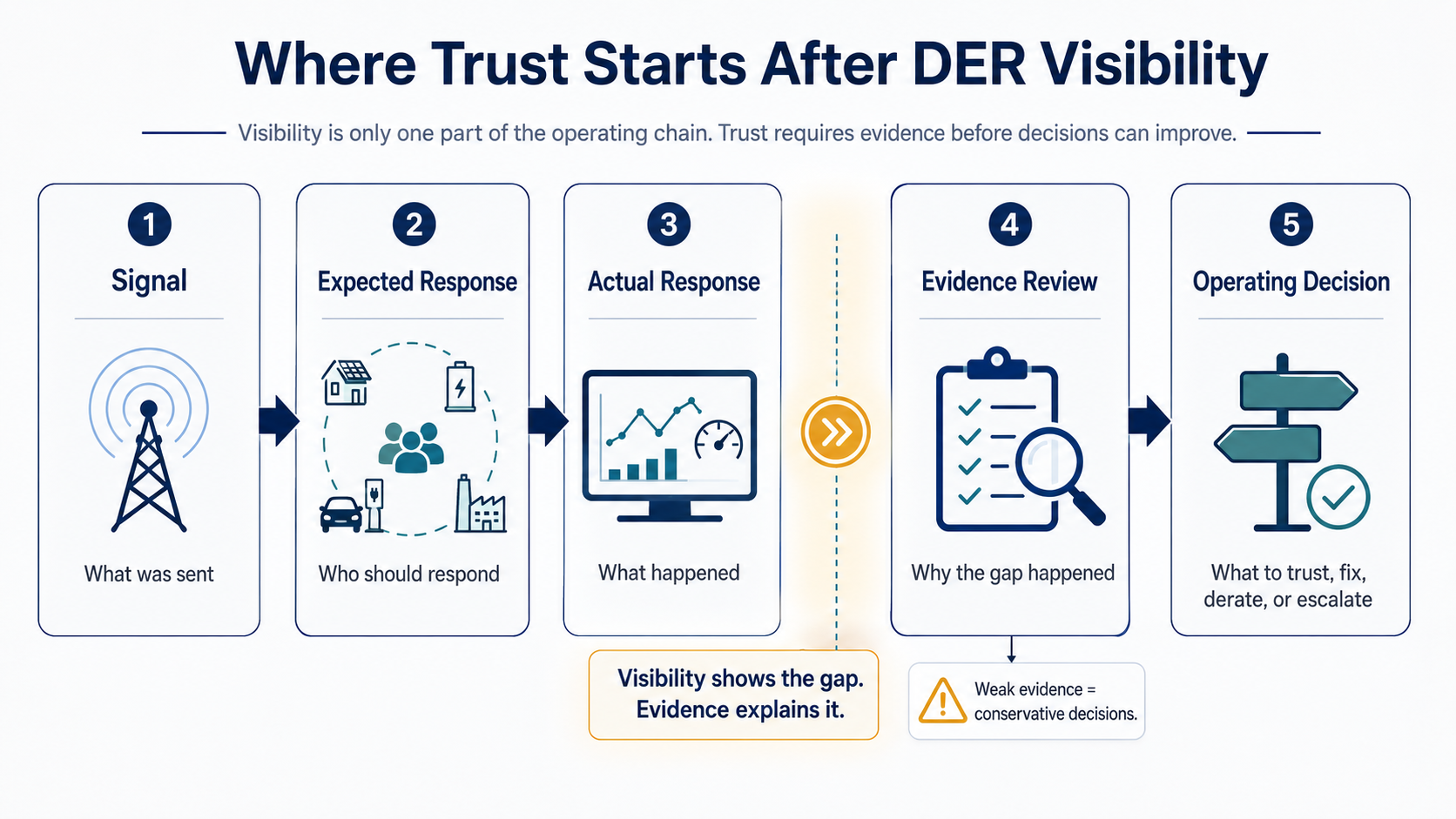
Most systems are getting better at the middle of that chain. They can show the expected and actual response more clearly than before.
But if the evidence layer is weak, the decision layer stays uncomfortable.
That is when operators fall back on broad assumptions.
“We probably need to derate that provider.”
“That pathway is unreliable.”
“That cohort is not worth leaning on.”
“We need engineering to look into it.”
“We cannot count on that capacity next time.”
Some of those conclusions may be correct.
But without evidence, they remain expensive guesses.
This matters because DER value leakage does not only happen during the event.
It happens twice.
First, value is lost when the fleet does not respond as expected.
Then more value is lost when operations and engineering teams spend time reconstructing what happened across signals, eligibility, control instructions, telemetry, pathways, cohorts, and metering.
That second cost is easy to miss because it does not always appear as a market settlement line item. But operators feel it.
It shows up as investigation load.
It shows up as conservative dispatch.
It shows up as delayed confidence.
It shows up as providers being derated.
It shows up as internal debate about what the fleet can actually be trusted to do.
This is especially painful as fleets scale.
At small scale, teams can manually explain enough of the exceptions. They can chase the data, ask around, compare logs, and build a reasonable view.
At larger scale, that manual explanation becomes part of the operating model.
And that is a problem.
Because the question is no longer simply: “Did the fleet respond?”
The better question is: “What does the evidence allow us to trust?”
That is a different operating discipline.
It means post-event review cannot just be a report.
It has to become a defensible response audit.
It has to show what was sent, who was expected to respond, what actually happened, where response leaked, what the evidence supports, and what still needs attention.
Not because operators need another dashboard.
Because they need a clearer basis for decisions.
Should this cohort be trusted next time?
Should this pathway be fixed?
Should this provider be derated?
Should engineering spend time here?
Should the commercial team assume this capacity is bankable?
Should the next event lean harder or stay conservative?
Those are not visibility questions.
They are trust questions.
And trust does not come from seeing more.
It comes from being able to explain what happened clearly enough that operations, engineering, commercial, and leadership can make the next decision with less guesswork.
That is where the next layer of VPP operations is starting to show up.
Not in sending the signal.
Not even in seeing the response.
But in proving what happened after the signal, and knowing what the evidence supports next.
— Pradeep
P.S. You've received this email because we're connected on LinkedIn. Feel free to unsubscribe if the insights are unrelated.