
Why VPP Scale Creates a Confidence Problem
The fleet you enrol is not always the fleet you can lean on. As VPPs scale, the hard question is not only whether response gaps happen. It is what those gaps should change next time.
Most VPP teams do not need to be convinced that fleet response is messy.
They already know the signal can be sent.
They already know the DERMS may show something happened.
They already know the actual fleet response can be lower, slower, or harder to explain than expected.
But the more important operating truth is this:
Operators derate what they cannot prove.
If a fleet, cohort, pathway, provider, or asset class does not consistently prove its response under real event conditions, it quietly loses trust.
It gets discounted. It gets watched more closely. It may be pushed lower in the stack. It may still exist in the portfolio, but operators stop leaning on it as hard.
That is where enrolled flexibility and bankable flexibility start to separate.
On paper, the fleet may be growing.
In operations, the usable portion may be smaller.
The hidden issue is not only whether response gaps happen. They will.
The issue is: whether the team has enough evidence after the market event to decide what the gap should change.
- Should this pathway be trusted next time?
- Should this provider be derated?
- Should this cohort be excluded from a future event?
- Should engineering spend time fixing this integration?
- Was this a real delivery issue, a telemetry issue, an eligibility issue, or a measurement issue?
That is the layer where VPP economics start to get uncomfortable.
A response miss does not only cost value during the event window. It creates uncertainty for the next decision.
And when uncertainty is unresolved, operators protect themselves by becoming conservative.
They lean less.
They discount more.
They over-investigate.
They build manual workarounds.
They treat some capacity as nominal rather than bankable.
This is why visibility alone does not solve the problem.
Visibility may show that response was below expectation. But it does not automatically tell the team what to trust next time.
Trust requires explanation. And explanation requires evidence that connects the event, the intended cohort, the control pathway, the telemetry, the exception, and the actual response.
A simple mental model helps:
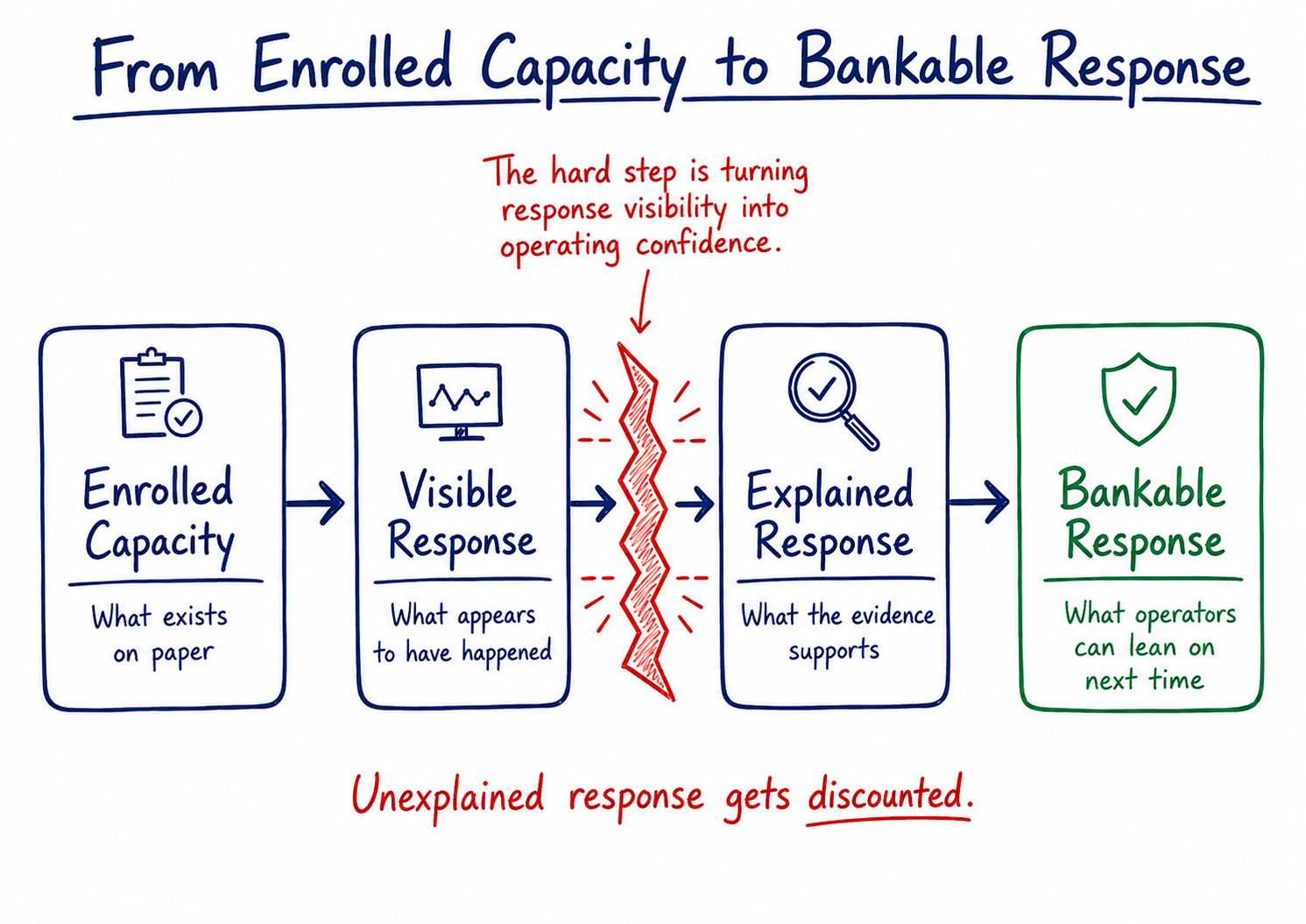
Enrolled Capacity → Visible Response → Explained Response → Bankable Response
Most teams are trying to move from the first box to the last one.
But the hardest transition is not from enrolled capacity to visible response. It is from visible response to explained response.
Because once response is explained, the operating decision becomes clearer.
You know which part of the fleet deserves confidence.
You know which pathway is leaking value.
You know which cohort needs attention.
You know where telemetry is not strong enough.
You know whether the gap is worth fixing, discounting, or accepting.
Without that evidence, the fleet gets derated by instinct.
That may be rational. Operators cannot risk leaning on response they cannot defend. But it also means value leaks quietly. The portfolio may look commercially larger than the response the team is willing to bank on.
As DER fleets scale, this matters more.
A small fleet can absorb manual review. A larger fleet cannot. More assets, more OEMs, more gateways, more signals, and more value streams create more places for confidence to break down.
The question becomes less:
“Can we send the signal?”
And more:
“What did this event teach us about what we can trust next time?”
That is the operating shift VPP teams are moving toward.
Not just visibility.
Not just analytics.
Not just more enrolled capacity.
A clearer evidence base for deciding what response is bankable, what should be discounted, and what needs attention before the next event.
Because in real operations, the fleet you can enrol is not always the fleet you can lean on.
And operators derate what they cannot prove.
— Pradeep (Helping you make that hidden middle layer profitable)
P.S. You've received this email because we're connected on LinkedIn. Feel free to unsubscribe if the insights are unrelated.